
Disclaimers: Our site uses demographic data, email opt-ins, display advertising, and affiliate links. Please check out our Terms and Conditions for more information. To see more of our content, set us as a Preferred Source in Google.
When we bought our dragonfruit cactus, we were pretty pleased that it came already at a sufficient size. At about 18″ tall with a few vertical shoots, we were well ahead of the growing curve by months if not a year compared to buying a smaller cutting or growing from seed.
So, naturally, our next question was simply “how long will it take for the dragonfruit cactus to flower?”
As it turns out, the answer was another 1 1/2 years, where we’d estimate our cactus was about 2 1/2 years old, if not a bit older.
But throwing out a date range for this one is a bit hard, as age may not be the only indicator of bloom. So in this one, we thought we’d tackle some of the prevailing theories on how (and when) a dragonfruit blooms to help provide more details you need to keep in mind- how you train your dragonfruit may matter too!
🪴 Dragonfruit Cactus Flowering – A Quick Look
- Many Theories: There are many theories out there on what triggers a dragonfruit cactus to flower, including that the branches must be tipped down, it must have sufficient plant mass (15-20 lbs), and that pruning may help trigger flowering
- A Combination is Most Likely: In our opinion, all of these likely work together as a sufficient mass is a sign that the cactus is mature, and downward pointing tips with pruning helps resources build up in the branches
- Two to Three Years Minimum: Our dragonfruit cactus did not reach this point until it was roughly two to three years old; however, flowers did not set and form fruit until after the third year- but don’t slack on proper training while you wait
Need to pick up some new gardening equipment? Click to shop today.
Theory #1 – Dragonfruit Branches Must Be Tipped Downward

As you may be aware, dragonfruit cacti are climbing varieties. They branch out, send out long shoots, and will grow upward as much as you can support them.
But take a look at any commercial operation’s trellising, and you’ll notice something- they curve the branches to start draping downward once the plants reach a certain height (often upwards of six feet tall or more), and all fruit generally seems to grow on these downward sections only.
So, why do they do this?
Well, as you likely know, nutrients are pulled upwards out of the soil through the plant until reaching the tips of each branch. This theory suggests that by pointing the tips downward, these nutrients begin to collect in the tips of the dragonfruit- perhaps more than they would than when growing vertically.
This growing concentration of nutrients is then taken as an indicator from the cactus that it is time to flower. So if you’re not training your branches to grow down, you may not create a scenario conducive to flowering!
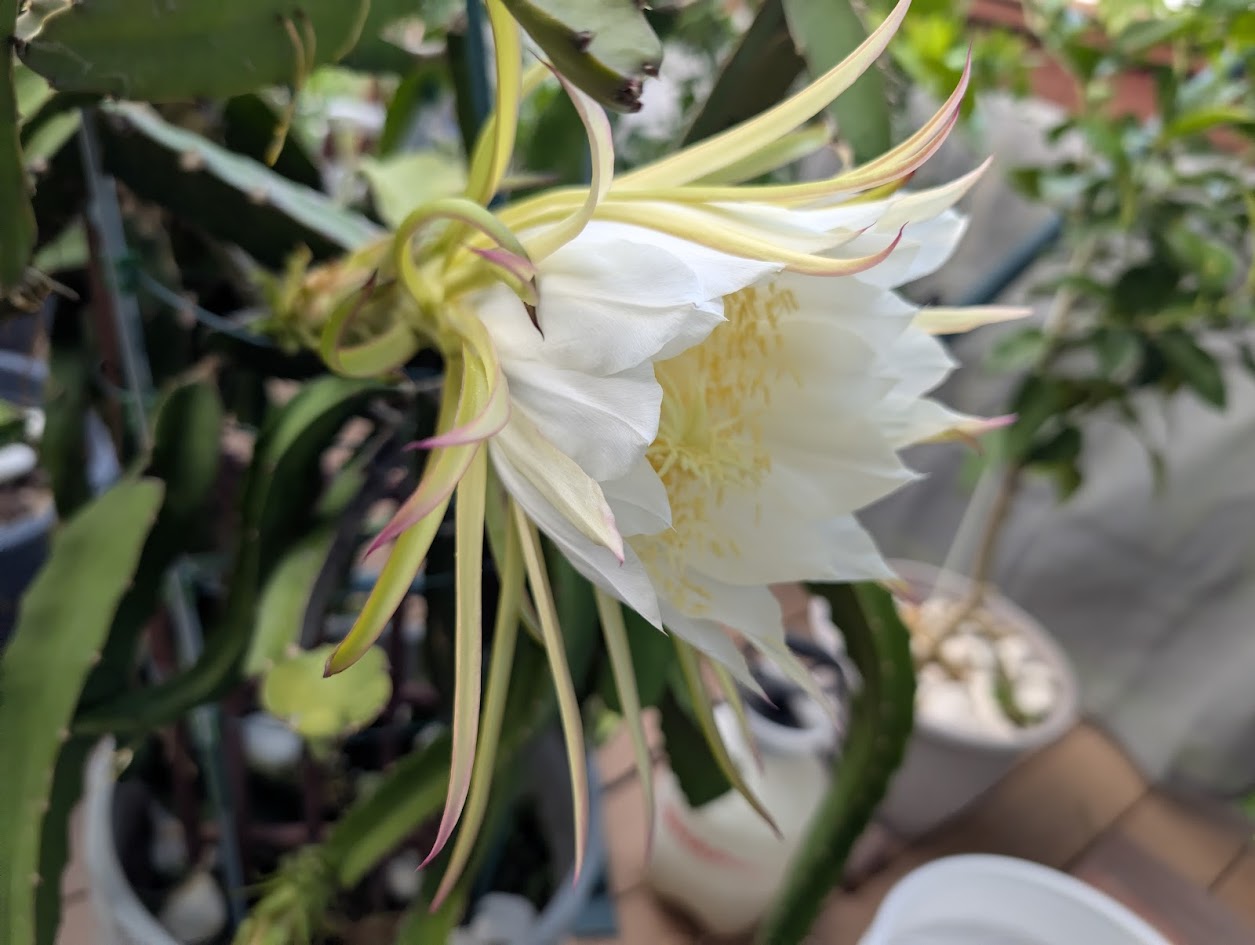
For us, we couldn’t grow our dragonfruit cactus six feet tall. Our pot is also fairly small and likely wouldn’t support that much plant mass anyway (let alone dealing with bringing it inside in the winter). But we did manage to start curling our branches over when the cactus was about 2-3 feet tall, with downward branches reaching about 1-2 feet that seemed to be enough as our cactus flowered with this setup.
Theory #2 – A Minimum Amount of Plant Mass is Necessary

A similar theory to the above is that it is not necessarily the flow of nutrients that triggers flowering, but the overall mass of the plant. I think these two theories are probably similar, if I am honest, because they’re both a sign that the cactus is reaching maturity- one based on overall size (mass), and one based on the orientation of the branches.
Are you likely to get fruit if you have just one vertical stock and one tipped-over branch? Honestly, that sounds doubtful even if the cactus is a little older. Ours didn’t start flowering until we had about 20 appreciable downward-facing branches, and an overall cactus weight of (by our estimate) 15-20 pounds plus the weight of the pot and soil.
The good news is that a cactus doesn’t have to be massive like commercial operations to flower, but we do suspect that you need to grow them fairly large to reach maturity either way, even if our definition of large here is not as much as you may otherwise expect.
Can a cactus flower with fewer branches pointing downward and a larger overall mass? We wouldn’t be surprised if the answer is yes. But since flowers typically appear on downward-pointing branches, we do have to admit that more branches likely will mean more chances to fruit, and likely a higher yield overall, so we trained our dragonfruit to have as many as we could.
Theory #3 – Pruning and Stress Triggers Flowering

The final theory we saw come up again and again is that pruning and other stress conditions are required to trigger flowering. This is a common occurrence with many plants, so we felt pretty comfortable with this one at the start.
Stress, like seasonal drought, causes a plant to go into preservation mode, and for many, that means sending out flowers in order to fruit, drop seeds, create offspring, and grow a new cactus if it were about to die. By this logic, a fruiting cactus should be no different, and the theory suggests that water restriction during the summer may start signalling it is time to fruit. This is exactly what happened to our cactus during a hot summer stretch as well.
But there are other conditions that theories would suggest help, like cutting the tips off the downward branches. Much like other plants, whenever you cut off the tip of a dragonfruit branch, it sends a signal to the plant that it is time to send out growth from earlier nodes. In some cases this could be vegetative growth (i.e. new branches) and in others it would be a signal to flower.
Triggering one over the other is hard, we admit, but if coupled with conditions of stress in a mature plant, you can see where this is going- you may get more flowers. So we tipped a lot of the branches of our cactus to see what would happen, primarily because they were already long enough as it were. In our first flush, we got flowers!
Our Thoughts? They All Work Together
Ultimately, I don’t think any one theory is perfect on its own, because they all work together.
Dragonfruit cacti seem to need a certain mass to be “mature” and start fruiting, like most plants. Most fruit grows on downward-tipped branches, so the nutrient flow theory may have some merit. Likewise, pruning and drought stress are also ways to encourage most plants to send out new growth, be it vegetative or floral, so we could see this one working as well.
This is why we think they all build off each other. Without enough mass, a pruned cactus may grow more branches (and we do cut off tips to encourage more growth!). Heat and drought often signal fruit. And so on. In a way, you really can’t have one without the other- at least until the plant is mature.
So really this comes down to a simple recommendation- train your dragonfruit to a sufficient height and then grow branches downward. Try to get 20 or so downward-facing arms. Keep building the plant out until it reaches about 15-20 lbs in mass. Then consider stressing the plant (or just waiting) to be in a good position to start seeing flowers!
In any case, all of this takes time, and do not be surprised if you have to wait two or three years, if not more, depending on how big the cactus was when you acquired it. But, as with all things growing plants, time is the biggest factor!