
Disclaimers: Our site uses demographic data, email opt-ins, display advertising, and affiliate links. Please check out our Terms and Conditions for more information. To see more of our content, set us as a Preferred Source in Google.
I had always known that growing wasabi would be incredibly difficult, with a low rate of success if you’re not in the perfect climate (which we’re not). But I did not expect every single one of my cuttings to die within a week or so after purchasing them!
As it turns out, this one is a really, really finicky plant to root. So let’s talk about that, and we’ll share some tips that may help if you’re in the same boat.
Note: I do not consider these tips to be foolproof. It is just that after numerous trial and error, it seems to be a recurring them that might help. That said, even in the best case, we expect a lot of loss- especially if you are buying non-rooted cuttings for our starting point.
Rooting Wasabi Cuttings Requires The Right Conditions
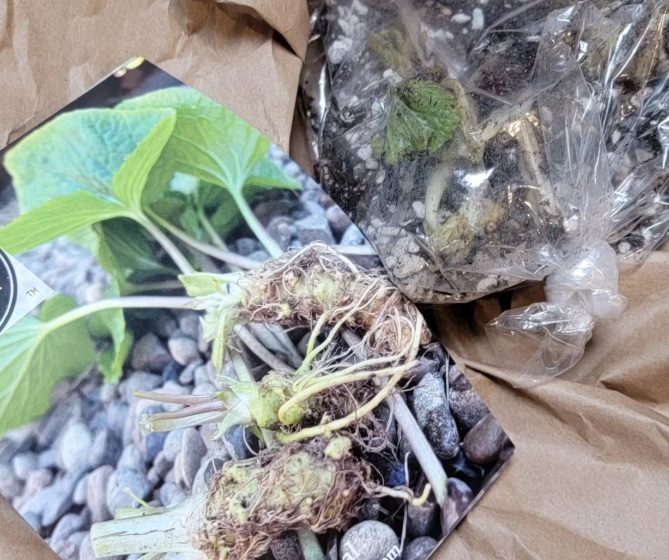
When you read about growing wasabi, you will quickly find out it requires precise conditions to grow, which are sometimes feel at odds with each other.
They like to be moist, but not wet, and also to dry out between waterings. They like moderate temperatures (50-70 °F consistently). They need pretty much full shade as best as possible. Our summers in Zone 7 are way too hot, and it is way too cold in the winter to grow wasabi outside- but we thought we could possibly make it work indoors as we keep our house more or less at 66-70 °F year-round.
So, I bought some cuttings to root, put them in fast-draining cactus soil, lightly watered them, and… they all died within a week. Oops.
It was then that I realized the instructions I had received were not nearly as detailed as they should’ve been, because this fast-draining soil clearly wasn’t good enough. That’s on me for thinking it would be fine, I’ll admit, but still I was left with three dead wasabi cuttings and a hole burning in my wallet.
But, not being one to admit failure, I doubled down, bought 10 more wasabi cuttings (partly because I received a significant coupon from a promotion), and tried again. One survived. I doubled down again, bought ten more, and zero survived.
It was with that trial and error process that I have landed on some tips that I think may help increase your odds of success- even if ever so slightly- but even with that, don’t hold your breath.
Solution 1 – Mix 50% of Soil with Perlite
Up first, let’s talk soil.
As you can imagine from our intro above, wasabi wants incredibly fast-draining soil to hit that moist, but not wet, and also periodically dry condition that is hard to achieve. Cactus soil alone was apparently not fast-draining enough, and we later found instructions that said to mix soil with 50% perlite to help facilitate a better drying experience.
These larger particles really do help increase drainage in pots, and even I was quite surprised by how much better adding perlite was for better draining. So, when in doubt, add some perlite to improve drainage.
Solution 2 – Keep Rhizome Bits Above the Soil
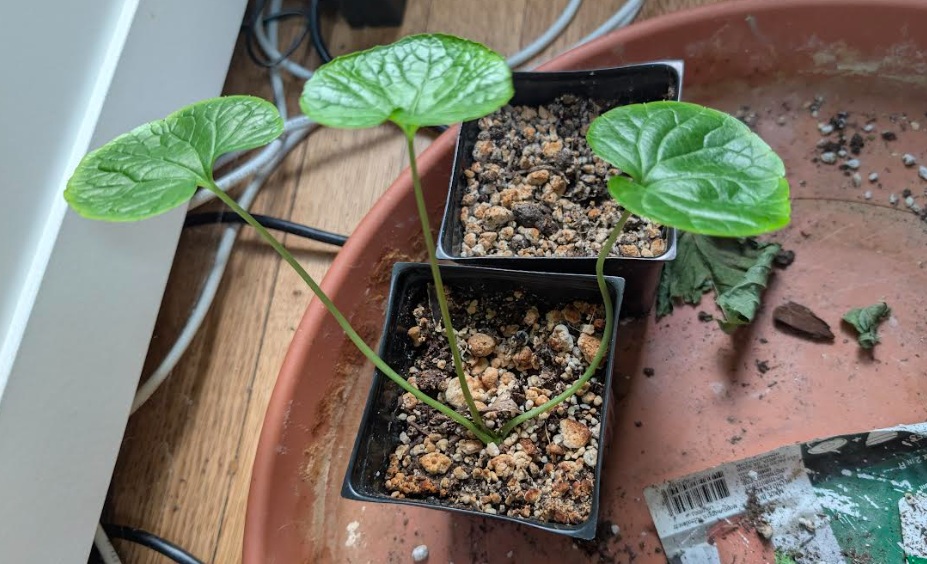
Since wasabi really doesn’t like to be super wet, it should be no surprise that we found that the suggestion for keeping any pieces of the rhizome above the soil line when planting is incredibly important.
Why? They rot out!
For every wasabi cutting that we lost, we saw a familiar trend, namely that the once hard rhizome started to rot below the soil line. The cuttings that didn’t had virtually all of the rhizome bits above the soil, and likely prevented excess moisture from contributing to internal rot before they could grow out roots to, you know, actually utilize the water.
So when planting, try and get any roots you may be lucky to have on your cuttings below soil, and keep the rhizome part above the soil as best as possible. All you need is a light bit of pressure to lodge it into place, and don’t go over the top with burying the rhizome or else you may risk it rotting before it roots.
Solution 3 – Water Sparingly
Naturally, the soil mix and planting strategy is only one half of the equation, and your watering schedule needs to be tailored to get to the conditions noted above.
Even with fast draining soil, I found that my mix stayed wet for far too long, which poses a special problem when the cuttings haven’t rooted, as the plants are not taking up a lot of the water to begin with.
So when you water, you really want to err on the side of less is more. I only had a light pour of water to wet the soil, and ensured it would dry out in between. Not too wet, not too dry, and keeping a balance between the two as best as possible. Yes, it is harder than it sounds, and yes, it does feel like it’s that important until roots are established and the plants start sending out new leaves.
Solution 4 – Buy More Than You May Need
Despite all this, and even with your best efforts, do not be surprised if some of your cuttings die. It’s just a fact of life that without roots at the start, you have to have a bit of luck on your side even with the best conditions.
One way to get around this is to use the brute force method we did- buy more cuttings.
Yes, our loss of upwards of 95% is terrible. Yes, we spent well over $100 in trial and error (and that’s with a coupon!) to make it work. Yes, you probably need to do the same.
Thankfully, a lot of places that sell cuttings may give a bit of a price break if you buy more, so if you’re considering two different packages, err on the side of caution and buy more than you need because you will likely lose many either way.
Solution 5 – Spend More on Rooted Plants at the Start
Our final solution is perhaps a non-solution, because it doesn’t involve trying to root a wasabi plant at all.
The truth is that trying to root wasabi cuttings is incredibly difficult. Even with a few attached roots (ours were very, very minimal almost to the point of a fault of the company we bought from), our failure rate in trying to establish these plant starts was worse than we would’ve liked. Given that wasabi cuttings, both with and without roots, are quite expensive, we really were just throwing money down the drain with this one.
I’ve never had such a hard time with plants before!
As such, perhaps the best solution is not to buy plant starts at all, and instead spend a bit more to purchase a fully rooted and developed plant to begin with. Whether that is a cutting with established roots or a live and growing plant with leaves (say, from a local store if you’re lucky to find one), these may give you a leg up on the success rate over what we had.
If I were to do it all over again, I’d rather spend $100-$150 to buy, say, 3-5 thriving plants than the same amount of money we did on cuttings with our current failure rate. Sometimes it really does help to just pay more and avoid the hassle, and this is one of those cases. Growing wasabi from cutting is really hard!
Do you have any tips to grow wasabi from a cutting? Comment to share!