

Disclaimers: Our site uses demographic data, email opt-ins, display advertising, and affiliate links. Please check out our Terms and Conditions for more information. To see more of our content, set us as a Preferred Source in Google.
As frequent travelers, one issue we’ve had with growing potted fruit trees is figuring out a watering plan for when we are away.
These plants are notoriously fickle with water, needing deep waterings with dry periods in between. Despite that, we found that while going away for a few days was often quite fine, being gone for 10 days or longer presented a challenge. No matter if the plants were indoors or out, we needed to water them, and leaving our watering up to others always poised a bit of an issue- namely, we don’t like to be a bother to our family and neighbors for as much as we travel.
It wasn’t until a friend recommended we pick up some self-watering stakes that we started to see a path forward. Water applied to our plants over time while we are away? We were in, and picked up a batch right away with some pretty encouraging results.
But, that being said, we had a few lessons learned when using these that we wanted to highlight to make sure you get the most out of your self-watering stakes.
🪴 Self-Watering Stakes – A Quick Look
- Siphon Method for Water Addition: Self-watering stakes are ceramic cones that pull water from a bucket using a siphon, and can apply 50-150 mL/day to plants per stake, on average
- Trial and Error: We recommend trying a test before leaving to make sure you have the best setup- you may need multiple stakes per pot, wet soil at the start, or elevating the bucket of water for best performance
- Better Than Nothing: For heavy water consumers, stakes may not provide their full water requirement over an extended period of time (i.e. weeks); however, it is a stopgap that is better than doing nothing
Need to pick up some new gardening equipment? Click to shop today.
More Stakes for Bigger Pots (or Longer Time Away)
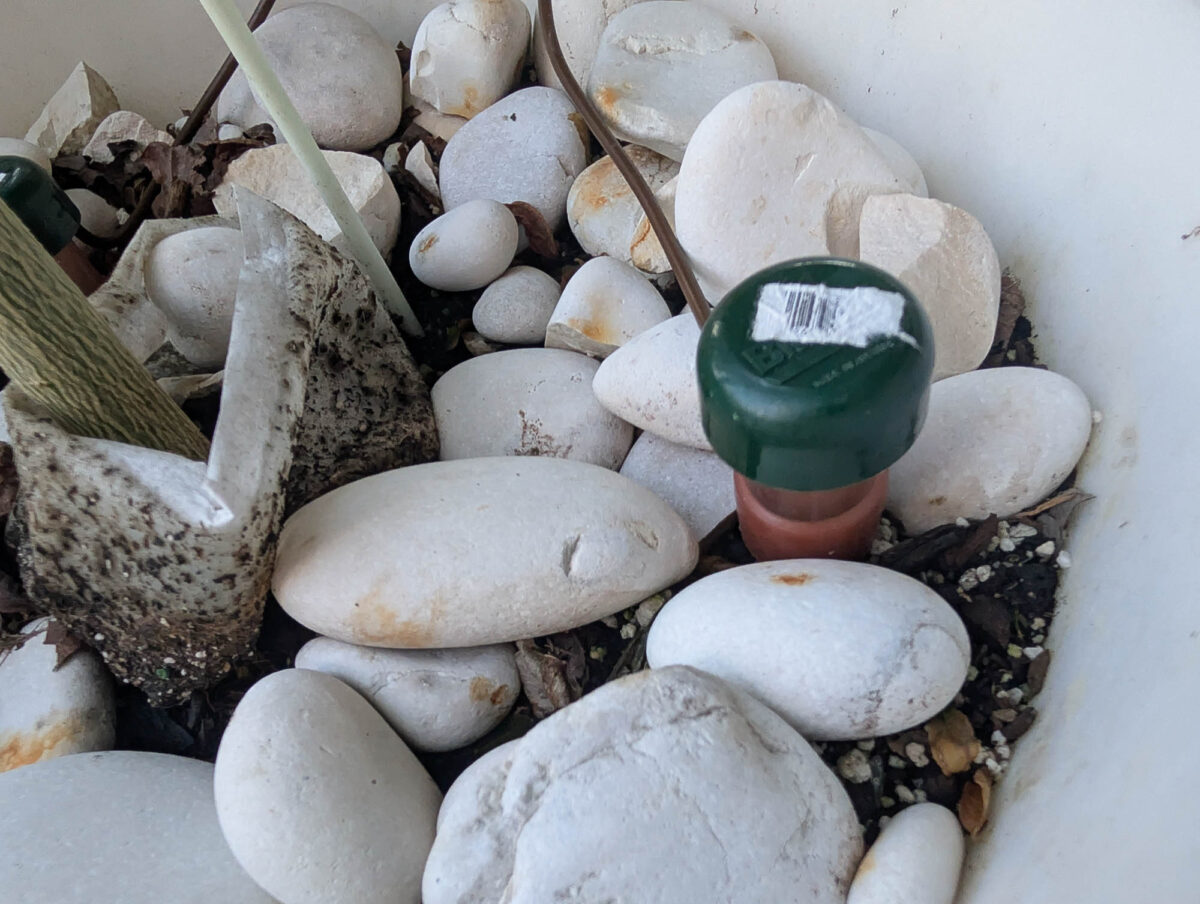
First up, no matter your setup, odds are good you’re going to find that the rate at which water comes out of the stakes is quite low relative to conventional watering. At normal conditions, a Classic Blumat stake may provide anywhere from 50-150 mL / 24 hour, depending on the water level in the bucket, and XL Stakes can be anywhere from 125-200 mL / 24 hour depending on your setup.
- These are ranges we found quoted from Blumat; however, your mileage may vary. As water levels drop, the drip rate will slow down.
For larger pots (and even smaller ones if you are gone for a sufficient period of time), you may find that the rate at which water gets added into the soil is insufficient for your plants’ needs over an extended period of time. If your plant needs 1 liter of water per week minimum, for example, and you are using a stake that may deliver 75 mL / day, you may need at least two stakes to get to that amount- and that’s if everything is working properly (which they often don’t- we’ll talk more about that in a second).
My citrus trees often need much more water when outside in the summer (7-10 liters per week at my current pot sizes), albeit with a period of drying out in between, so you can see how you could run the risk of underwatering here. I’m fine with this in the short term, a few days drying out doesn’t hurt citrus trees, but an extended period, especially at elevated temperatures, can do some real damage!
One way we got around this issue over time is simply by acquiring more stakes and adding them to our pots. A small ~12-18″ diameter pot with fast-draining soil (such as for a tropical fruit tree), we may add two, whereas a much larger pot at 24″ diameter, we may add three or more at different areas of the soil to ensure the entire root system gets some water over time- not just one side.
This doesn’t supply most of our citrus trees with the full amount of water they need to thrive, but it does provide more than nothing, which helps us extend our time away with less (but not perhaps completely no) worry.
More Buckets of Water
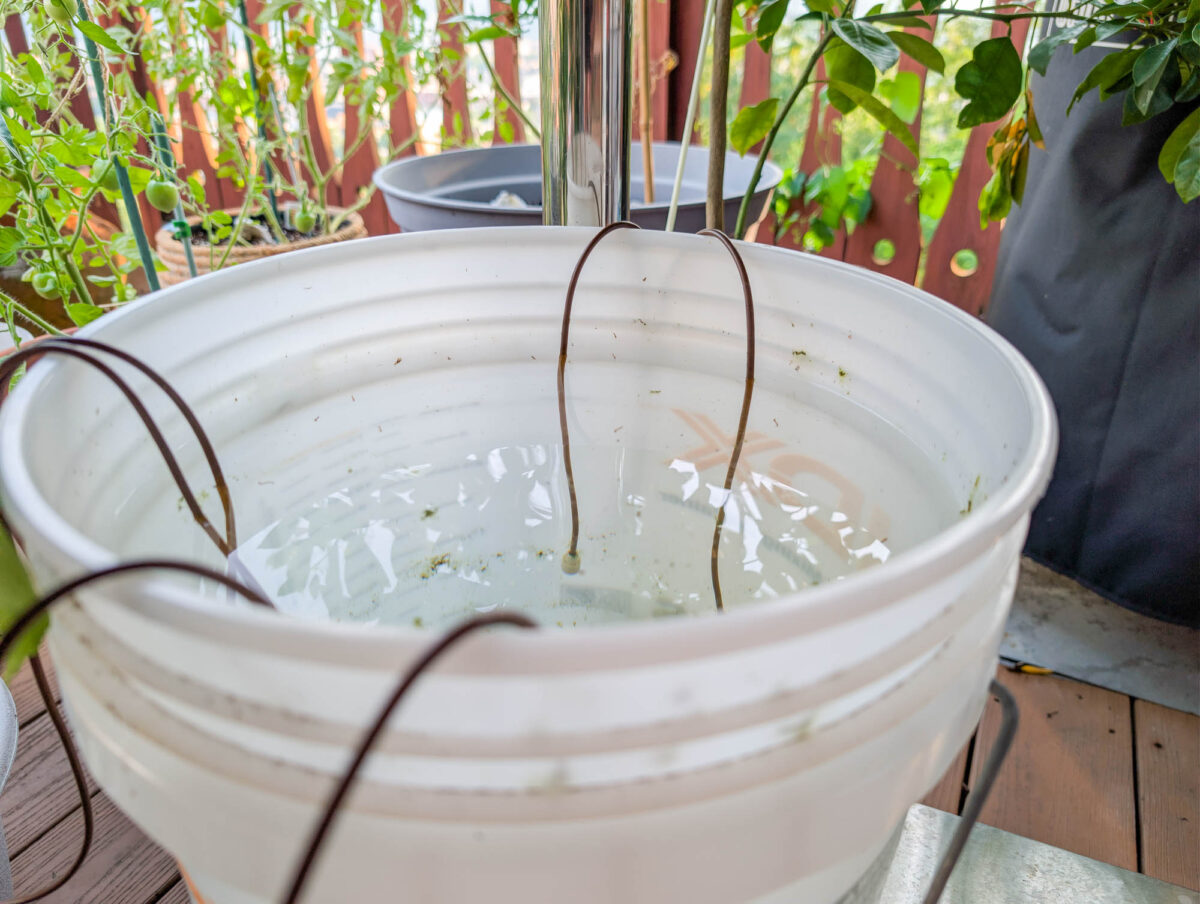
On the same hand as having more stakes, you may want to get more buckets of water outright.
This one solves two problems in one go.
First, more buckets mean more available water that can be added to your plant while you are away. For extended stints away from home, we ask a friend to come and top the buckets off (and perhaps give the plants a little direct watering, if needed). But if we cannot do so, having more water reservoirs on hand means more water that can, over time, be added to your plants.
- As noted above, water application rates drop considerably as the water level decreases in your buckets, so having fewer plants consuming water per bucket will help keep the application rate higher- albeit ever-so-slightly.
Second, and on a more practical note, the tubes of the self-watering stakes are alarmingly short. Most buckets of water need to be within 1-2 feet of any given plant, and that is if we are stretching things. When trying to have one bucket give water to two, three, or four+ plants, we simply can’t group the pots close enough to allow the tubes to go far enough down into a bucket to reach the bottom.
So, the solution to both of these issues is to buy more buckets if you are watering multiple plants! For our 12 tropical fruit trees, for example, I can get by with grouping them rather closely and four buckets (about one bucket per three plants), but even there, that’s a stretch. Your ability to move plants close together could vary considerably here.
Elevate the Bucket
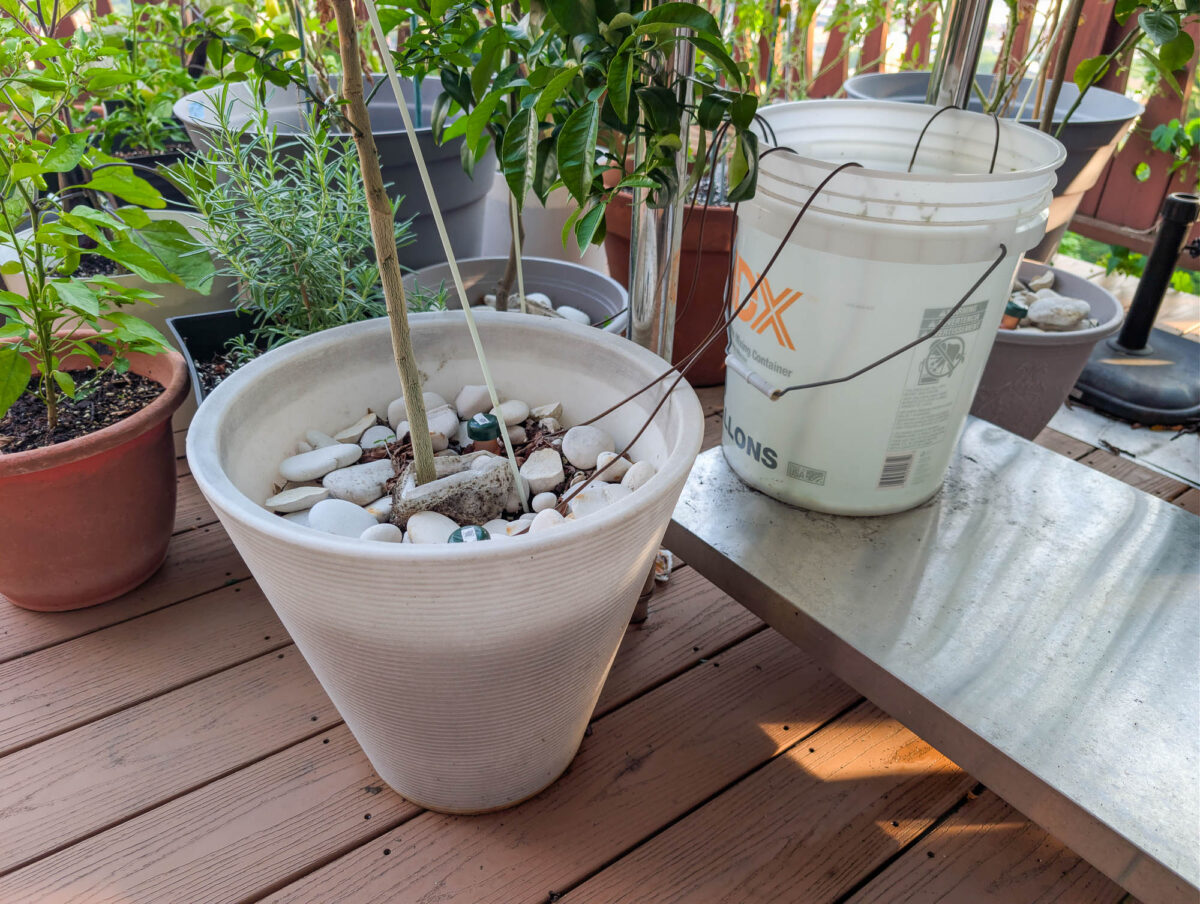
Self-watering stakes use the siphon method of watering, in which water is pulled through the tube, and the stakes create suction that helps draw more water down. But what you may not realize here is that the relative elevation of the water in your bucket and stake in the soil also plays a factor in getting to that range of rates we noted above (these are often discussed in the instructions for stakes, but who reads those anyway?).
To put it simply, the lower the water level relative to the stake level, the less water will be pulled via siphon. Adding extra height from the surface of the water level relative to the stake can increase your watering ability a great deal.
For a Classic Blumat stake, for example, water that is more or less in line with the green cap of the stake discharges at 75 mL / 24 hr. But if the water level is lower by several inches, the discharge rate decreases- they did not give a height difference here to compare, but we’d estimate that at a six-inch lower water level, you’d maybe see a drop to 50 mL / 24 hr. Conversely, if you raise the water level several inches, you may see an increase, with a comparable rise perhaps going upwards of 150 mL / 24 hr.
This can be done either by filling a bucket of water higher, or, if you are able, stacking the bucket on top of a stand (we use bricks) to help increase the overall water height as well. Doing so helped us increase our water pass-through rate and get to a better watering scenario for our thirsty citrus trees.
- Note: If you have your water level too high, and for plants that may not need as much water, you could result in an overwatering scenario. So if you are watering indoors with a saucer below, make sure it is sufficiently large and test it before leaving your house for an extended period of time.
- As mentioned many times in this article, water distribution rates will fluctuate as the water level in your buckets drop. Elevating the bucket is simply a good starting point to start at a better application rate if your plants require it.
Start With Wet Soil
Before diving into this one, I want to say this one is probably more of a personal theory, but as I was a water engineer for many years prior to blogging, I think it is a pretty good one- start with wet soil when inserting your stakes.
One thing about ceramic cones and the siphon process that I feel like isn’t mentioned as prominently as it should be is that it works off osmotic pressure and diffusion. That is to say, the ceramic cones release water to be in equilibrium with the soil around it (read: wet), and the cone refills by pulling water out of the bucket to always stay full.
In my experience, you’re not going to see a scenario where the cones keep adding water until the entire soil in the pot is the same degree of wetness. It will let water leech out such that the immediate soil around it is wet, but that water will then diffuse out to smaller and smaller concentrations until a point at which soil a certain degree away from it does not receive any additional water.
This is why I add several stakes to each pot- I’m just not convinced that the limited water that is applied will sufficiently wet an entire pot of soil.
I, personally, think that you’ll likely have more water pulled through starting with wet soil, as the cones will meet a sort of equilibrium with the wet soil around it, and I could, in theory, see a scenario where dry soil may not pull as much water simply because the cone is releasing in balance with the soil around it as well.
Now, of course, this could be wrong, and at the same time, starting with wet soil also just means a longer period of time before the plant dries out entirely, such that less additional water is even needed at all, but, hey, I’m allowed to have my theories. In either case, give your trees a good watering before adding your stakes.
- Anecdotally, I set my self-watering stakes up once after watering really well, left for a few weeks, came back, and my plants were fine. In a second instance, I set up my stakes without watering really well, as I was letting my trees dry out a bit after long rains, came back, and my plants were severely dehydrated.
- This is likely mostly due to the limited watering capabilities of these stakes, as discussed above, but I do think that starting with hydrated soil probably helps performance to a degree.
Watch Out for Clogs
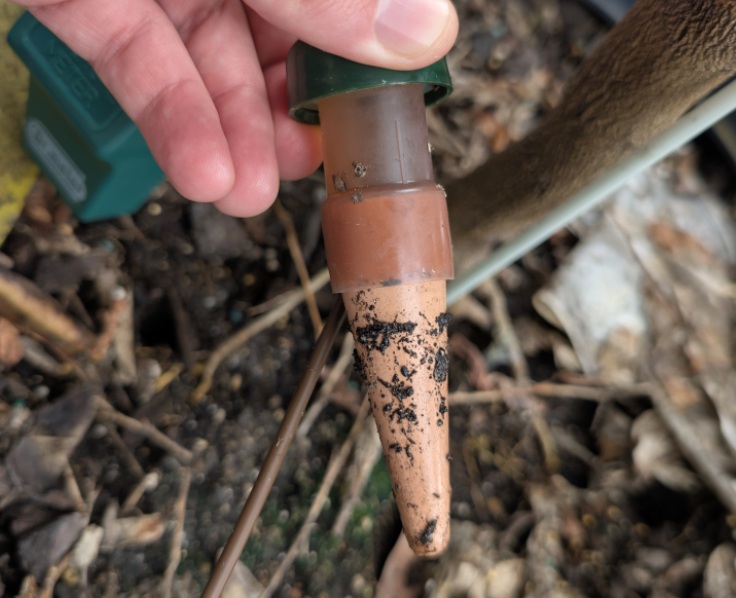
Finally, we’d be remiss if we didn’t point out that the stakes can and do seem to clog with wet soil over time (but, much like the last point, this one is simply a theory that we, and our friends, have considered). This may also reduce the rate at which water is pulled from any given stake.
We’ve found that cleaning these off in a sink does the trick after each use, but we still remove the stakes when not using them, clean them up, and put them in storage until the next time we are unable to water regularly.
I do not believe these should be used for continual watering 24/7/365, as you could likely see a performance dip over time as the soil around them clumps up and potentially restricts water flow. In my (and my friends’) experiences, a few weeks can be quite good, but a month or more, and performance becomes questionable.
Can I say with absolute certainty that this performance is not tied to another factor, like water levels dropping? To be honest, no, but I have noticed that longer use has resulted in more soil being pulled out alongside the stakes, which also seemed a bit clumpy, so I could see where this could be a potential issue in the long-term, too.
The Good News? You Can Test While at Home
To end this one, perhaps the best piece of advice I can give is that the good news is you can test your stake performances when at home. You do not need to wait until you leave for a vacation to see how these work in action.
All you need to do is follow the tips mentioned above, set up the watering stakes yourself, and then wait a period of time and see how your plants respond. Can you make it two or three weeks with the stakes watering just fine? How is the water pull-down rate? Will the buckets need to be topped off? Or perhaps someone to swing by after 7-10 days to give the plants a proper watering to provide a hedge?
You won’t know these things when you are gone. But you can mock test before leaving if you order your stakes and buckets early enough, which is highly recommended.
I did not do this, and after having issues, I did do a test on my own while at home to see if they helped- particularly during a hot, dry, summer stint where we didn’t have a lot of rain. That observation period helped me quite a bit, and some of those lessons learned made it into this article outright.
So get those watering stakes and buckets early, give them a test, and then put your plan in action when you leave!
Do you use self-watering stakes in your plants? How do they work for you? Comment below to share!