

Disclaimers: Our site uses demographic data, email opt-ins, display advertising, and affiliate links. Please check out our Terms and Conditions for more information. To see more of our content, set us as a Preferred Source in Google.
Before getting into growing citrus and tropical fruit trees, I admit that I thought it would be a much easier undertaking.
Yes, I know that growing tropicals in pots in Zone 6b/7 is sometimes a lesson in futility. And, yes, I knew I would deal with some struggles, particularly around bringing the plants inside during the winter.
Three things I did not expect, however, were how much these trees consume nutrients, how bad pests (in our area at least) could be, and associated disease pressures that would still need to be managed.
So over time I built up a nice little collection of fertilizers (both macro and single nutrient) as well as insecticides to help keep my trees as vibrant and healthy as they can be. So in this one, I thought I’d talk about each and why they will likely be needed at some point in your future.
Citrus Fertilizer Granules
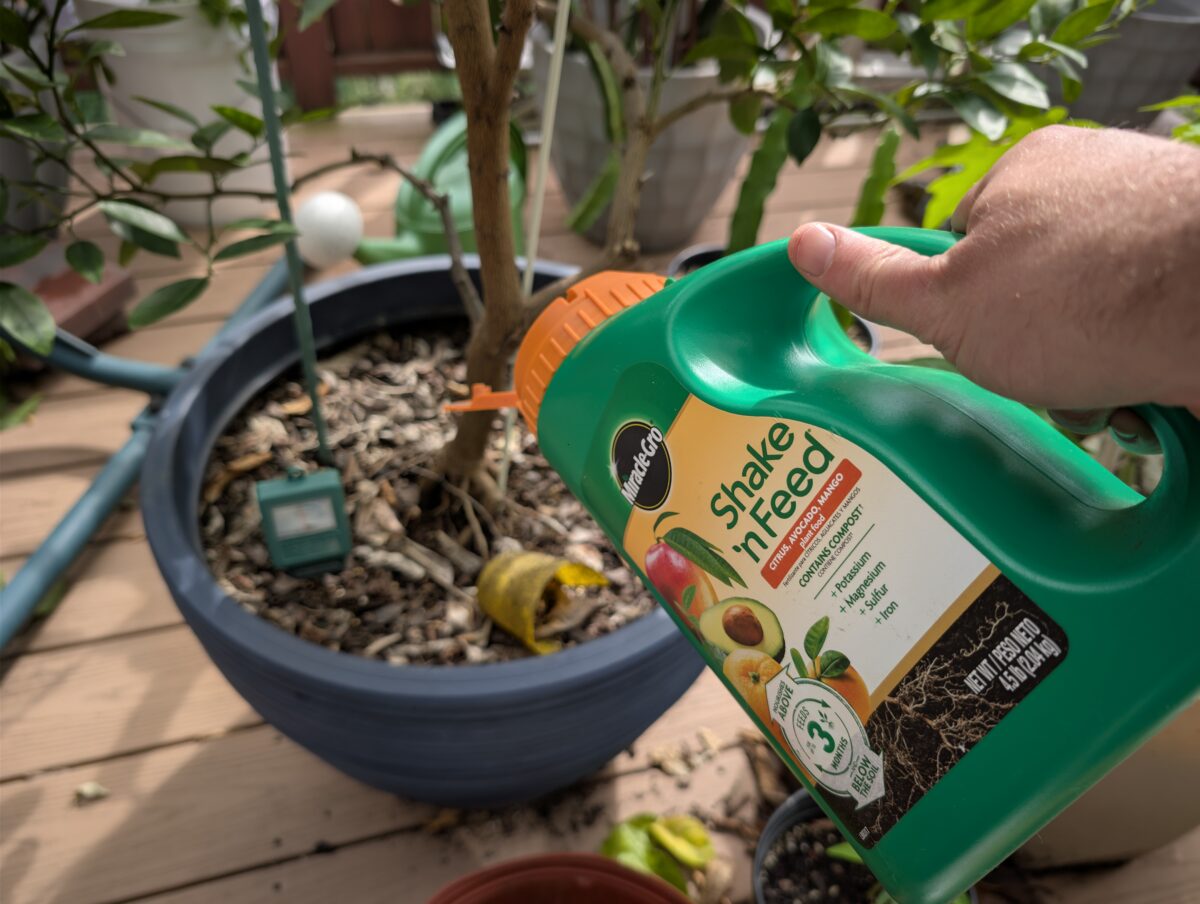
Citrus trees are voracious feeders and need regular fertilizer applications to stay healthy throughout the growing season. We can break these up into macronutrients, typically found in fertilizers as Nitrogen, Phosphorus, and Potassium (NPK), as well as an array of micronutrients, which we’ll get into in a moment.
First, you’ll likely want a few bulk fertilizers on hand with high levels of NPK in various proportions (such as 10-10-10 or 6-3-3), plus micronutrients. Nitrogen, for example, helps trees grow with new leaves. Phosphorus helps with root development and flowering. Potassium is necessary for fruit ripening, quality, and yield, among others.
Fertilizer granules are a bit of a set-it-and-forget-it macro fertilizer approach, as they are often slow-releasing over weeks/months. When properly dosed, they’ll slowly break down over time and continually release fertilizer in your soil- perfect for a long-term game during the seasons you should be fertilizing your plants.
Fertilizer Powder
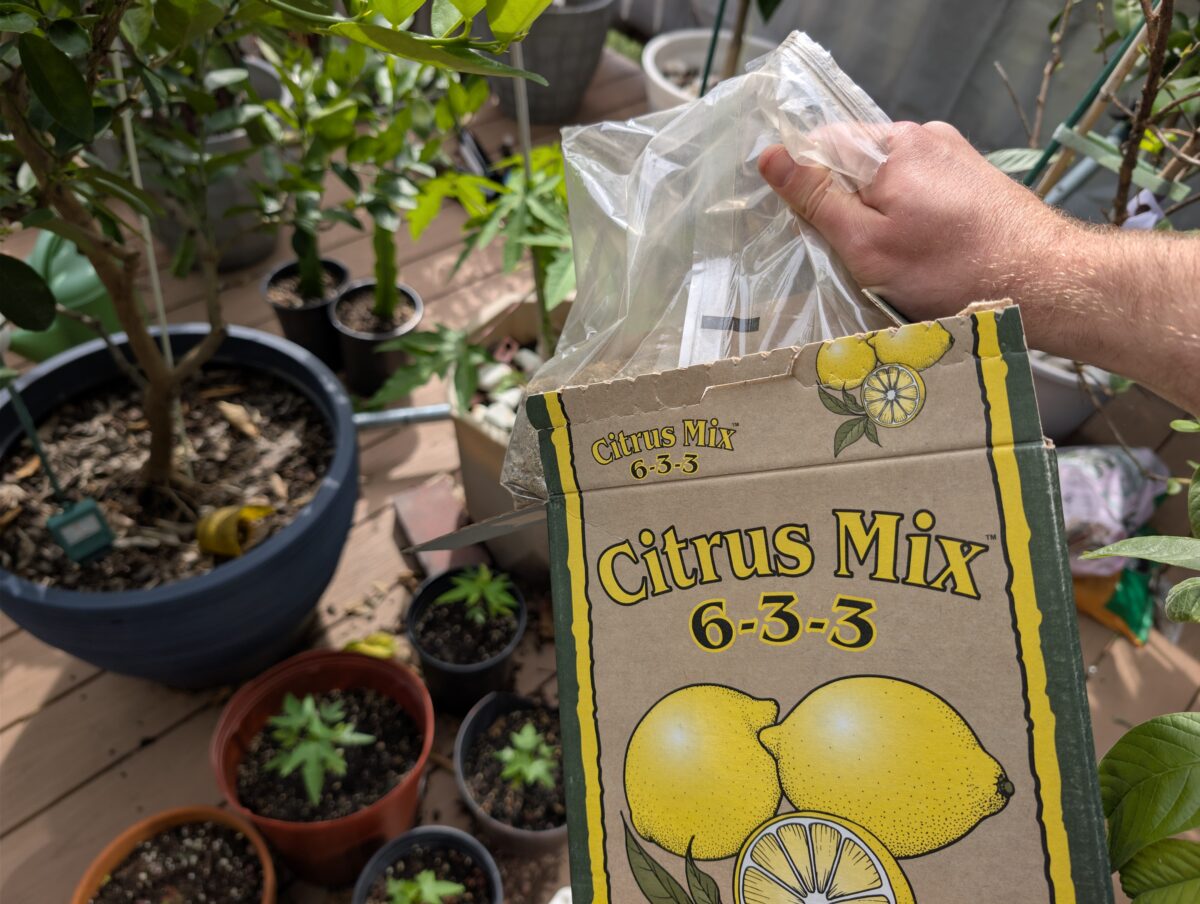
Of course, fertilizing is always a game of balance as too much fertilizer can burn the roots of your plants, and not enough fertilizer can leave your plants hungry for more.
We often underapply fertilizer pellets, as we have killed our share of trees over the years by adding too much fertilizer beyond what a tree could tolerate. Thankfully, fertilizer powders are a bit of a hedge between the applications.
Fertilizer powder tends to have two benefits in that they are often low-dose (such as 6-3-3) and a fair bit faster-acting than granules. So if you want to give your plants a little fertilizer kick without overdoing it, an extra shot of fertilizer powder can be a good interim option if your trees seem to be needing a nutrient boost of NPK.
Liquid Foliar Spray
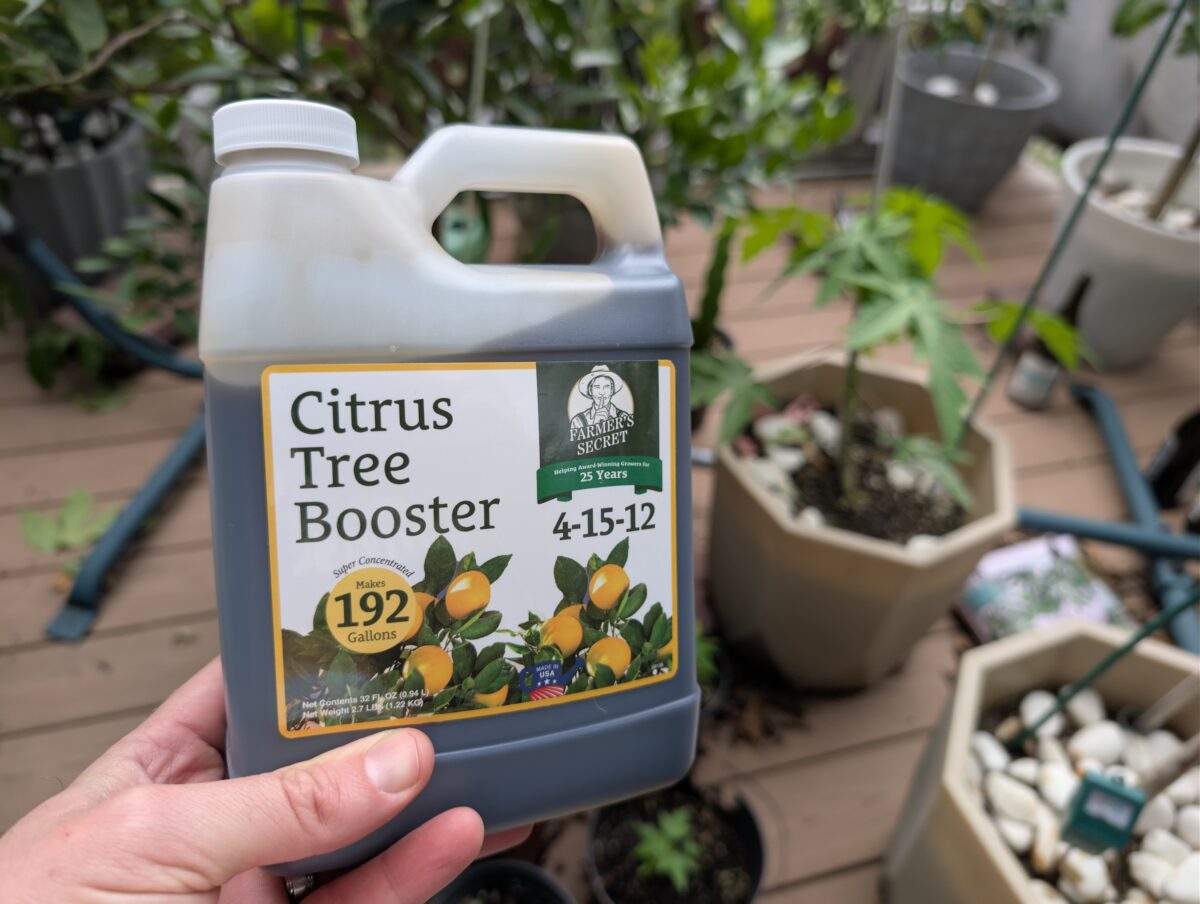
Of course, since everything is about balance, you may find a time when your plants are severely under-fertilized despite your best efforts. Here, additional powder applications may have an issue of being slow to uptake, and in some emergency cases, liquid foliar spray applications are needed.
The reason for this is that foliar applications of fertilizer is quickly absorbed via the leaves of a plant. There is no time required for the nutrients to dissolve, be absorbed by the roots, and transferred up to the leaves- it is being applied directly in spray form.
For us, this typically happens in tandem with another issue on the plant, such as overwatering or root burn from too much fertilizer application. There are many theories as to why these cause issues, but the recurring theme is that stressed plants (especially in the previously mentioned scenarios) will have trouble absorbing nutrients at all. So a water-logged tree may not be getting any nutrients to its leaves as the roots are struggling/rotting, and a foliar application can help provide some much-needed nutrients while the roots dry out and recover.
Suffice it to say, we treat this one as an emergency supplement only while trying to fix other issues.
- Tip: We like buying any liquid sprays in concentrate form and using an industrial sprayer for application. This is primarily because we have many fruit trees and consume individual spray bottles far too quickly (read: the cost adds up) whereas concentrates can provide many more applications overall. A broader discussion of this can be found in our article on why you may want an industrial sprayer for plants. We will be linking to concentrates for some of the products recommended here, but pre-batched spray bottles are also available for most as an alternative if you do not have a large plant collection like ours.
Micronutrients – Iron, Magnesium, and Potassium
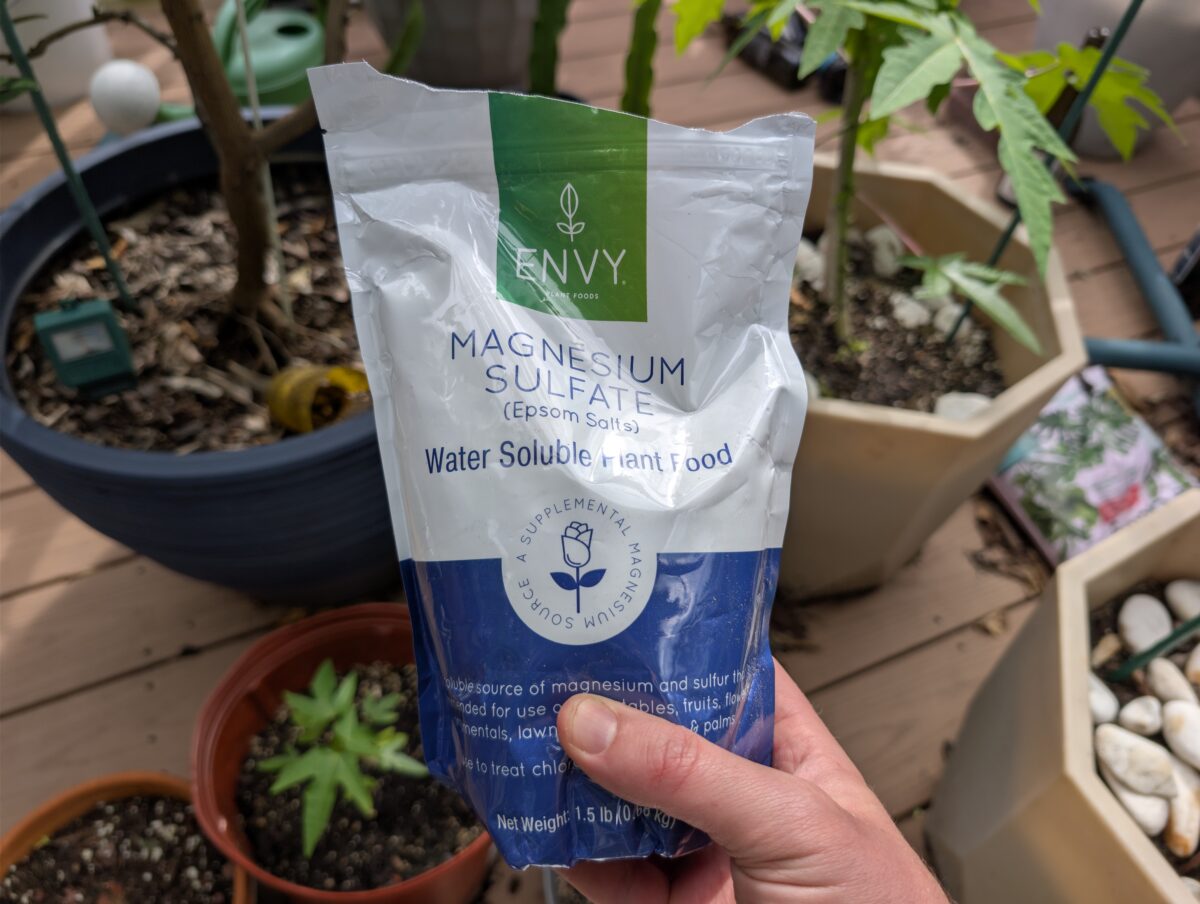
Now, Nitrogen, Phosphorus, and Potassium are not the only nutrients that plants need to thrive. They need all manner of nutrients, be it iron, magnesium, additional potassium, and more, in small doses.
Many of these nutrients are found in macro fertilizer blends, but over time, your plant may need a shot of things beyond what a typical application provides.
Potassium, for example, helps induce flowering and fruit set. You’ll get good dosages in macro nutrients, above, but since plants are strong consumers, you may find you still need more from time to time. Iron and magnesium deficiencies can be observed in the leaves similarly to nitrogen and phosphorus. You may want to observe your tree’s health for more visual observations of any given deficiency, but over time, you absolutely will need to start dosing micronutrients as needed.
For us, our trees tend to get an extra shot of potassium right before the fruiting season. Some trees need an application of iron every year or two (depending on size). We’ve just now had to add a little extra magnesium as our trees are approaching three to four years old. There are even more you may need over time, too (like zinc), but we also have not personally encountered that one yet.
Suffice it to say, fertilizers are good for bulk applications and overall health, but you will need to do some fine-tuned adjustments with your citrus trees over time all the same.
- Warning: Many micronutrients come in high concentrations such that you may only need a teaspoon or tablespoon per gallon of water (if that). Our bag of potash, for example, is 0-0-60 and will likely last us several lifetimes. So not only should you be quite careful when making your dilutions for a water-based application, you’ll probably need a little bit of storage room for your new-found micronutrient collection somewhere.
Copper Fungicide
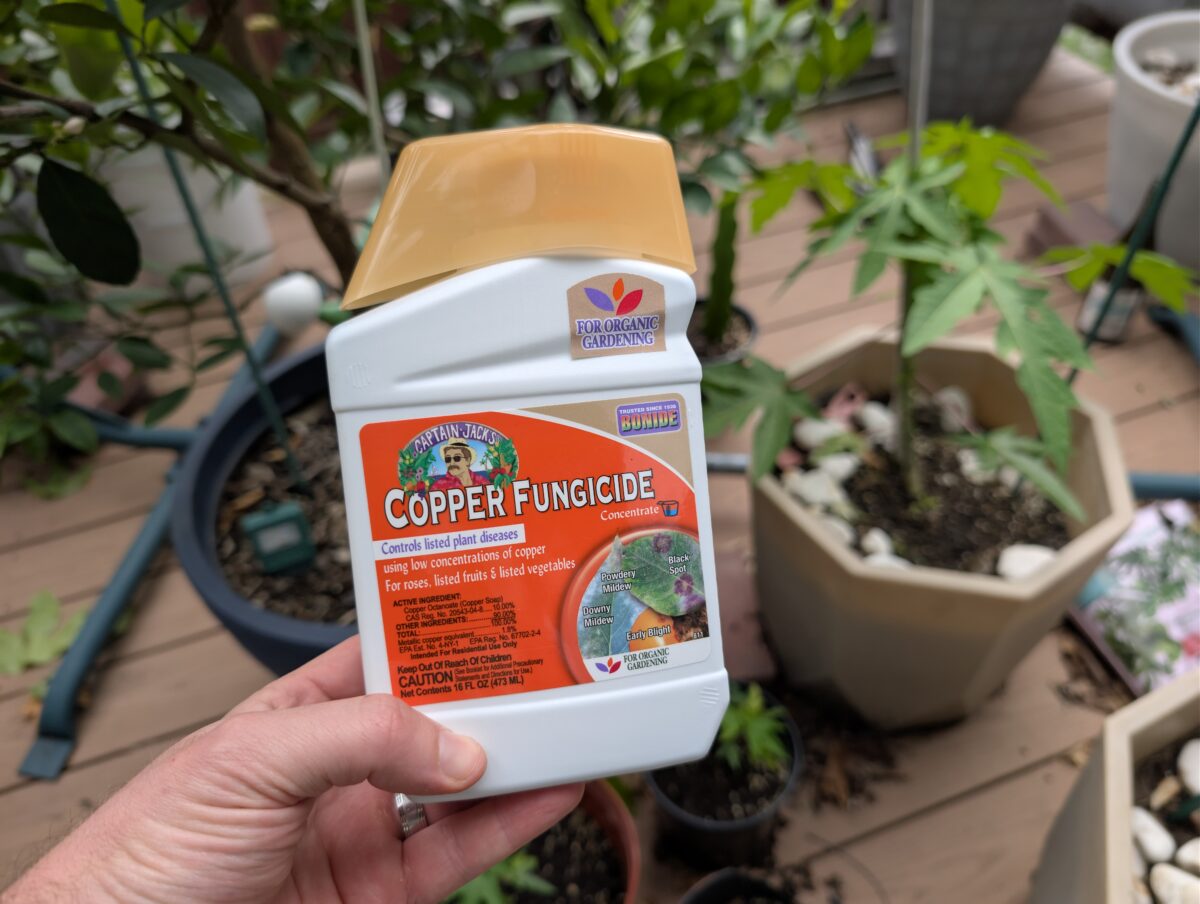
If you live in a wet and/or humid environment, odds are good your plants are going to acquire a mold or fungus at some point, such that drying the plant out alone may not solve the problem on its own. Copper fungicide is a good option to help knock down pathogens alongside environmental changes.
Copper has an interesting impact on these pathogens, as the ion helps inhibit growth and has been used in an array of plant applications over the years.
You may decide to use copper fungicide only when you start seeing bacteria or fungal infections begin. Or, if you are in a wet climate with a long streak of rain, you may apply a spray periodically after prolonged rain as a preventative.
Still, water breeds mold and fungus, and odds are good you’re going to need a copper fungicide for your trees sooner rather than later.
Pest Sprays – Insecticidal Soap, Neem, and Horticultural Oils
Finally, we come to pests- the ever-present array of bugs that will no doubt try to call your fruit trees home.
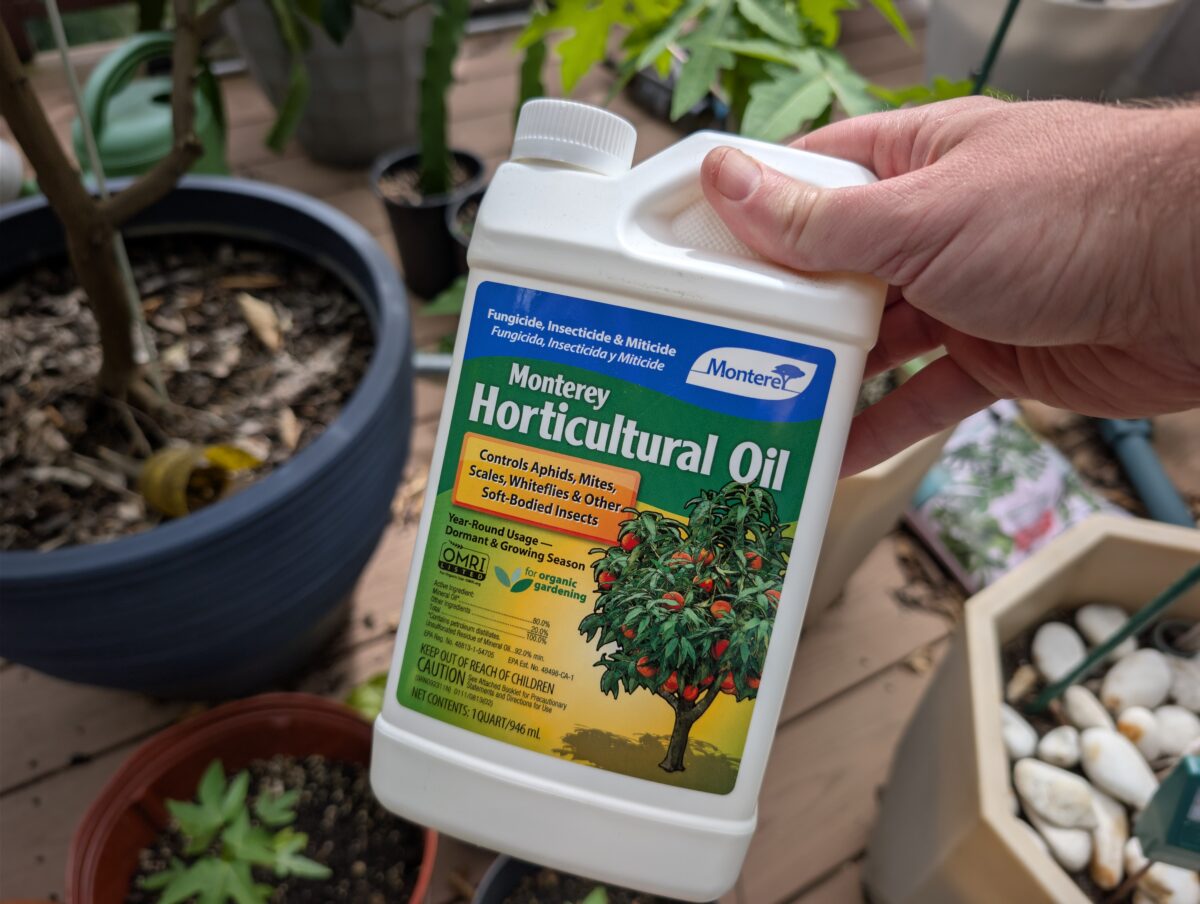
There are two (or three, depending on how you look at it) categories of pest sprays you will likely need, namely horticulture oils and insecticidal soaps. These spray applications work a bit differently from each other in how they treat pests, which is why you may need to have each on hand depending on the pest.
Insecticidal soap is best against pests with soft shells, as the soap coats the bugs and kills them on contact. Horticultural oils, on the other hand, work on a larger array of pests, either by having a deterring scent, coating, or, in the case of Neem, azadirachtin, which disrupts many pests’ ability to grow or reproduce.
In our experience, none of these are perfect solutions. Insecticidal soap works on some pests. Neem works on others. Horticultural oil seems to be effective in the gaps, too. Rather than trying to identify every pest that we’ve come across and isolate a spray that works individually, we use all three in a rotating succession, seemingly with decent results.
As previously mentioned, if you go down this route and have several trees, we recommend buying concentrates with an industrial sprayer, and share more as to why that is at the previous link (with a quick summary being you get more applications over time, which saves money, and seemingly better effectiveness when batches are made fresh from concentrate).
- Be careful when applying horticultural oils, as they are a bit more indiscriminate in how they work. Beneficial insects can be killed by these if covered by a spray, too.
Diatomaceous Earth
Finally, we should note that the above insecticidal soaps and oils are typically best for treating pests that are found on the trees themselves and not in the soil.
You can apply some insecticides to the soil with some degree of success. Some insecticides can also be applied as a soil drench that, some argue, is transmitted through the tree and kills sap-sucking insects when they feed on your tree. But in our experience, at least, we’ve found they vary in effectiveness (it is really hard to measure in the short-term, to be honest- they could be working or they could not be, we really can’t tell).
For soil-based pests, you have two options. First, you can (and should) let the tree dry out. Most pests will not thrive in dry soil conditions outright. But for some significant infestations, such as gnats, we come to the second option- adding diatomaceous earth to the soil when dry.
Diatomaceous earth is a very fine powder (wear gloves, a mask, and apply outside- it is light, fluffy, and prone to go everywhere even by breathing on it) that has, for insects at least, sharp, microscopic crevices on every piece. When a small pest walks across diatomaceous earth, it gets scratched and cut and tends to dehydrate and perish.
The only downside to diatomaceous earth is that your soil needs to be really, really dry for it to be effective, as it will absorb out moisture immediately and go from soft and fluffy (and deadly to insects) to a gloopy mess that is ineffective in a hurry if any moisture is present. So the two options really should be used in tandem here- dry soil and diatomaceous earth as a combo is a one-two punch for decreasing soil based pest populations.
- We also wrap the trunks of our trees with one-sided sticky tape when they are inside in the winter if we have gnat infestations that aren’t extreme enough to warrant the hassle of dealing with diatomaceous earth. We do not recommend this when outside; however, as tape catches everything indiscriminately- including beneficial pollinators.
Phew, that’s a lot!
Truthfully, if you are getting into growing fruit trees, particularly tropical fruit trees that are heavy feeders and temperamental around pests and fungus, the above fertilizers and insecticides are not only recommended, but, rather, are effectively a requirement.
This truly is not a matter of if you will need them, but when. So keep many of the above in mind when your plants have signs of struggle. Do your best to properly identify the issue. Buy a fertilizer supplement or insecticidal/fungicidal spray when needed, and make sure your plants are as healthy as they can be!