Disclaimers: Our site uses demographic data, email opt-ins, display advertising, and affiliate links. Please check out our Terms and Conditions for more information. To see more of our content, set us as a Preferred Source in Google.
If you are new to beekeeping, odds are good you are quite eager for your first honey harvest.
Even after being into this hobby for many years now, we still get excited every time harvest approaches.
But you may be wondering, “is it time to harvest?” and the answer to that question is a resounding “it depends.” So in this one, let’s talk about all of the cases you may want to look for to determine if it is time to harvest honey from your bee hives!
🐝 When to Harvest Honey – A Quick Look
- Capped Frames are a Sign: The traditional sign that your honey supers are ready to harvest is that the frames will be capped with wax, indicating that honey is below a safe hydration percentage to store (14%-18% typical)
- Frames Don’t Need to Be Capped: Although the rule is often to looked for capped frames, as long as honey is below 18% hydration, it is safe for long-term storage- checking uncapped frames with a refractometer is a safety check
- Make Your Life Easier: Waiting until multiple frames are full or the season is over is also recommended as extracting honey is a time consuming and messy process whether you are harvesting one frame or a dozen supers
Need to pick up some new beekeeping equipment? Click to shop today.
Capped Cells on Super Frames
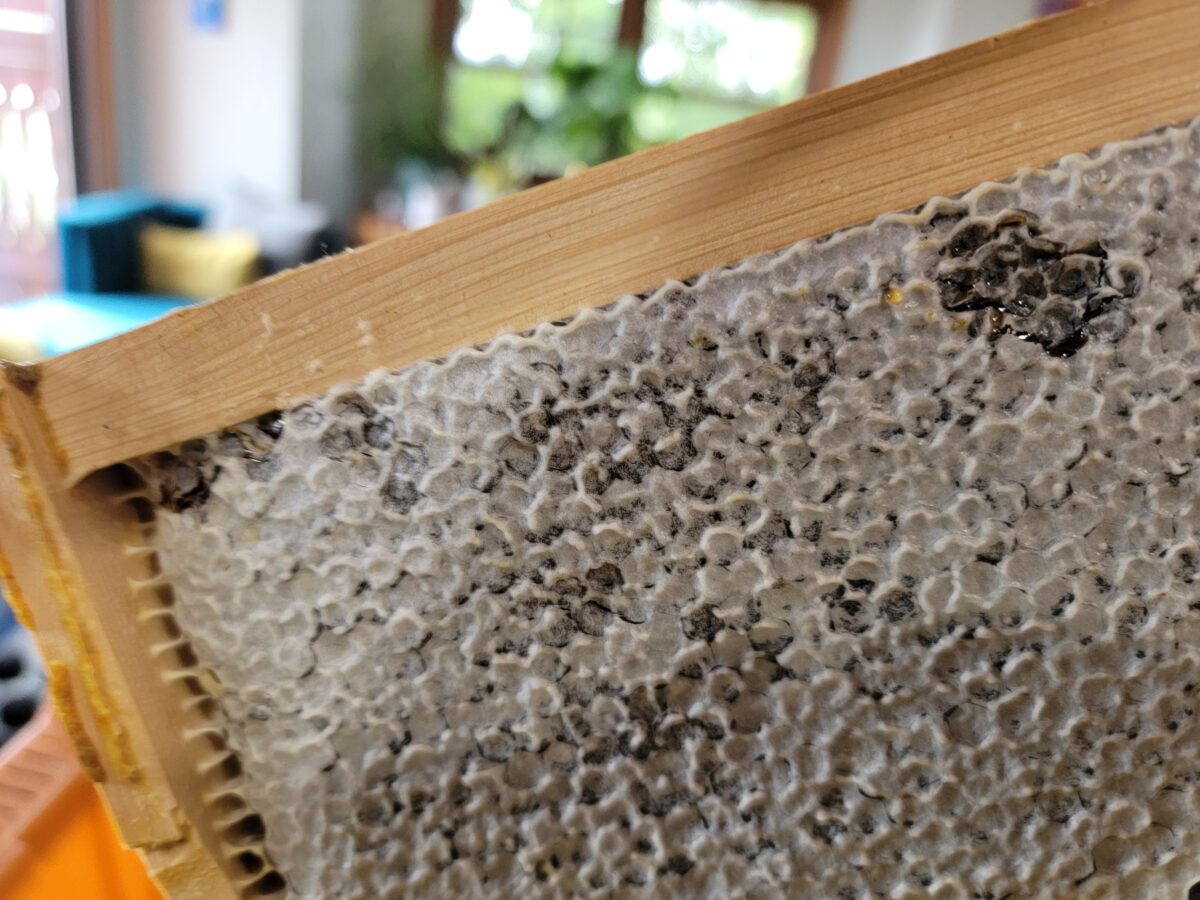
For most beekeepers, the tell-tale sign to look for that a frame of honey is ready to harvest is to look for a capped frame in your super.
If you have the bulk of a frame capped in wax, and no accidental brood present (a sign that your queen somehow made it into the super), then your frame is, effectively, ready to harvest. This is the ideal condition and, hopefully, you enter a super towards the end of a nectar flow and find many, many frames that have a perfect look to them.
We really don’t need to touch on this one any longer because it is the ideal condition. So let’s talk about some of the alternative scenarios you may see in a bit more detail!
Hydration Percentage

Capped cells aren’t the only indication that your honey is ready. Uncapped honey could be ready to harvest if one specific condition is met- it is under about 18% hydration.
As you likely know already, bees do not bring back honey directly from flowers. They bring back nectar and pollen, which is added into frames; moisture evaporates, the nectar concentrates, and over a brief period of time (a few weeks) turns into honey we know and love.
But why does the hydration percentage matter? Well, it is all about stability. Over about 18% hydration, the nectar is too wet and may not be shelf-stable. It will, over time, ferment or mold. But below 18% hydration, honey becomes stable for long-term storage, and beekeepers will do well to ensure that their honey is below this percentage after extraction at all costs. (Most honeys land somewhere between 14%-18%, for reference.)
As noted above, the first way to tell this is to look for capped frames. Bees won’t cap their honey unless the hydration percentage is already correct, and if your frame is 80%+ capped, it is pretty safe to assume the hydration is fine. You may get some honey at higher hydration into the mix (you can always check the uncapped cells if concerned), but overall will likely average out to < 18% in your extraction vessel.
If you are a bit bolder, however, you may consider harvesting frames that are not 80%+ capped; to do so, you may want to check the hydration percentage of several cells with a refractometer. Take a sample of the honey, put it on the device (clean, with no moisture residue), look through the viewfinder, and check the hydration percentage. Repeat this across many locations on all frames.
If the bulk of the nectar is well below 18%, you may be safe to harvest. If you’re hovering around there, with many data points higher, you run the risk of the hydration being too high unless it’s getting blended in with honey from capped frames.
For us, we tend to avoid harvesting frames that do not have a sufficient percentage of capped cells. But if we are in the middle of a harvest and trying to decide on one more frame that is partially capped, we’ll tend to swing the frame through the air to remove any loose nectar (higher water content nectar tends to come off when swinging the frame), test the hydration, and then make an in-the-moment decision on if it is worth harvesting that frame or not. (Most commonly this is around our last harvest of the year, as earlier we can leave the frame on and wait for the next nectar flow.)
An Entire Super is Full – Ideally Multiple
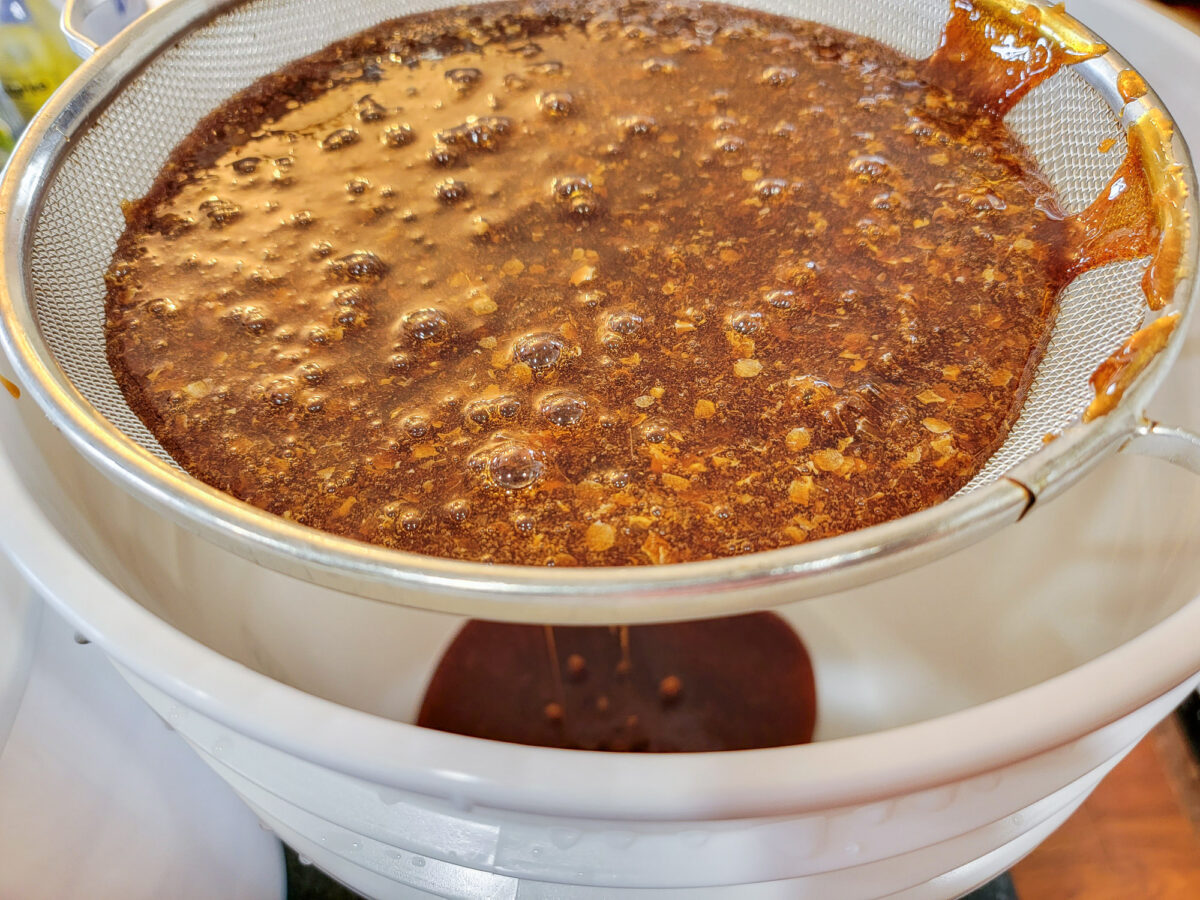
In the first point, we mentioned briefly that in an ideal world an entire super would be full of capped honey. But we’d go further and say ideally we would like many supers full of harvestable honey.
This has little to do with the performance of your hives and yields, to some degree at least (noting that we recognize every apiary is different), and more because processing honey from frame to jar is a pain in the butt.
Whether you are doing the crush and strain method of harvesting or putting your frames through a centrifuge to spin out the honey and not destroy the cells, two consistent issues come up time and time again- it is messy and time-consuming.
Wax? Everywhere. Honey? Everything gets sticky. The effort required to extract honey and the subsequent cleanup for one frame is often comparable to that for an entire super, or even multiple supers!
So, although I’ll be completely honest and say I did harvest one frame of honey in my first year as a beekeeper because I could, I honestly really don’t like having to go through the effort unless I have enough extractable honey to make it worth my time. So if nectar flow is still going on and your supers still have space, you may want to consider waiting to do more frames in one batch and save yourself a headache!
- Many beekeepers add more supers onto hives that are producing well during a nectar flow in order to harvest only once per flow; however, if you do not have additional supers and frames, you may want to harvest when you’re completely maxed out on honey (a good problem). But if nectar flow is still going on, be sure to get those frames back on the hive quickly, as your bees may be able to add more resources for another harvest! We, sadly, have yet to have this good of a problem with our hives, but we do have a few extra supers on hand just in case.
Dearth is Here
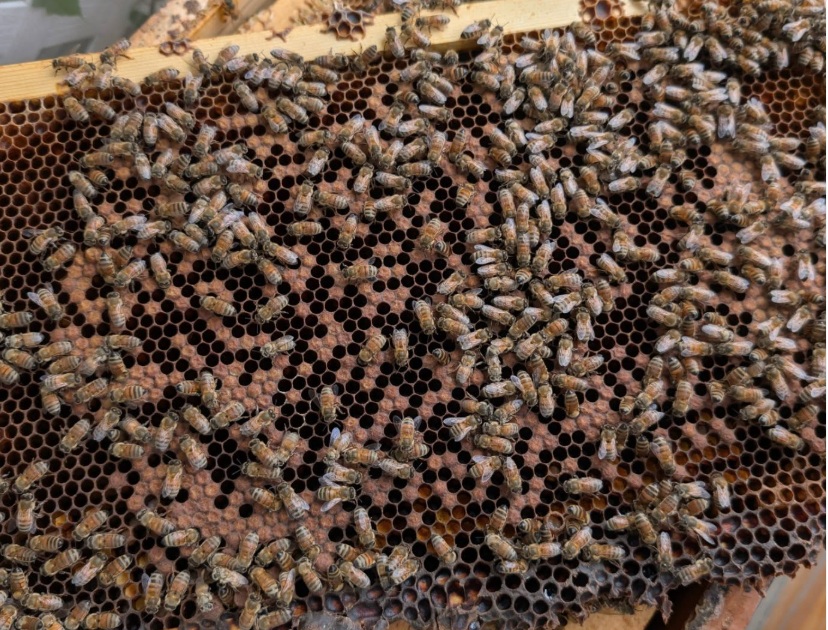
Of course, there is another tell-tale sign that it is time to consider harvesting your honey- nectar dearth has arrived!
Dearth is typically defined as any period of time in which available resources in your area dry up and bees are foraging less and preserving and consuming resources in their hive more. This happens in many regions at the height of summer, when warm days and reduced flowering make finding resources tricky, as well as in winter, when most plants are in dormancy and/or it is too cold for bees to forage (bees typically won’t fly far from the hive when it is below about 50°F).
Many beekeepers simply keep adding supers as bees fill them with nectar, wait for signs of dearth, and harvest everything in one go. You may not have many extra supers and get lucky and harvest mid-season when you run out of room, but waiting until the start of dearth ensures that you have every drop of honey you can get out of your frames from that season.
There are some downsides to harvesting in a period of dearth, however.
First, if you wait too long, bees may start consuming their extra resources. This means that they can start consuming honey in the supers if you don’t get to them first. It is, after all, the whole point of why they store honey.
Second, bees can become quite aggressive in protecting their honey in periods of dearth relative to nectar flows, where they can be much more docile. Be careful when entering hives when dearth hits as your bees may be more aggressive than usual. I, personally, like to harvest honey while the nectar flow is still going on if only because my bees don’t seem to mind when I steal frames out of supers.
In any case, dearth is a sign that the current season’s flow is likely over, and if you’re trying to harvest a specific type of honey (be it from a blooming plant, general season, etc.), it is a time to consider harvesting if other conditions have been met.
Plenty of Reserves in Brood Chambers
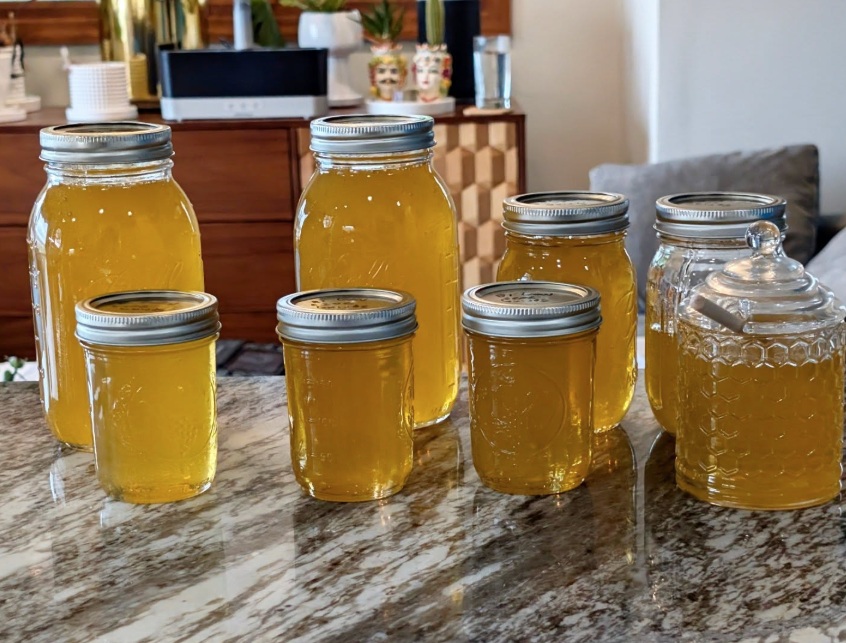
Finally, we have one last sign to look for when it comes to harvesting, and that is your bees have plenty of honey in lower chambers.
Bees need anywhere from 30-80+ pounds of honey per hive to make it through winter dormancy, depending on your region and how long winter lasts of course, and if you talk to a dozen beekeepers, you may get a dozen different responses on how much honey they look for the bees to have before harvesting any.
As noted before, we’re taking the excess for ourselves when harvesting, and overextracting honey could risk your hive’s chances of survival in the winter as if they run out of honey, you either will be rushing around in an emergency to feed them, or the hive may die outright.
For me, I run two deeps as my brood chambers, and come late October, I can normally get a feel if they have 50+ pounds of honey by investigating how many full, capped frames they have in the boxes. A full deep frame can hold about 6 lbs of honey (or ~4 lbs for a medium), so if I have about nine or ten frames of full honey between the two boxes, ideally several more, then I am comfortable in assuming that I can take the excess in supers for myself. Other beekeepers may leave an entire super on to have plenty of resources, too- it really depends.
This is more of a problem for fall harvests in my opinion, but at the same time, honey is for the bees first and us second, so don’t over-extract resources at any time if you are able.
Bees surviving until the next season is the first goal of beekeeping, after all! (Because, trust me, it gets expensive to replace lost hives- ask me how I know.)
Overall, although looking for capped frames of honey in a super is an excellent sign that it is time to harvest honey, there are several other conditions you may want to think about and look for before you start pulling frames. But, as every beekeeper is different, you need to figure out a plan that works for you, your hives, and your specific circumstances as it is truly a case of your mileage will vary.
But from there, pull that honey and enjoy your sweet, sweet reward!
Are you preparing for your first honey harvest? Make sure you have food grade buckets, ideally a bucket with a spout, and many Ball jars!
Start an Apiary Today
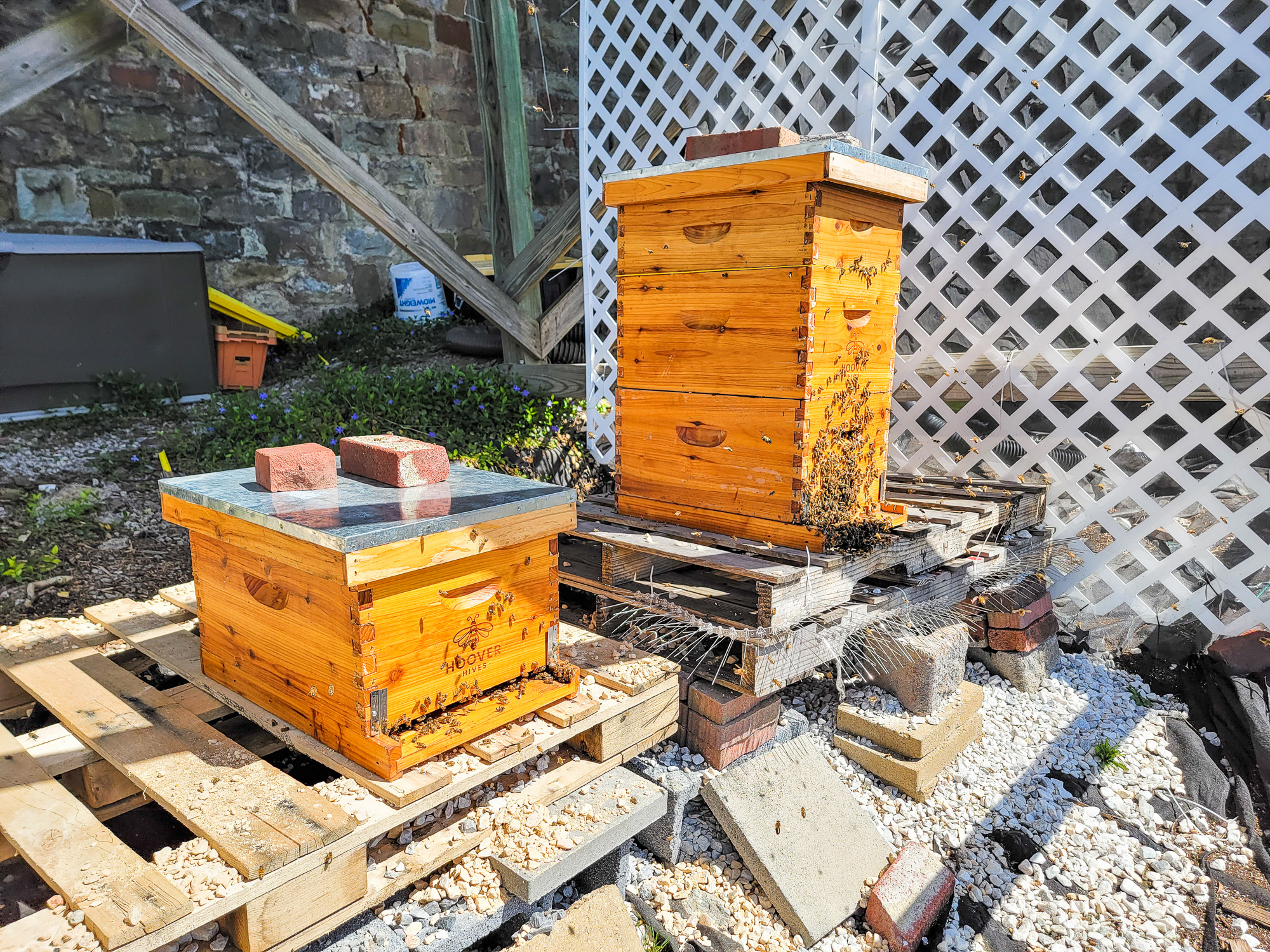
Looking to get into beekeeping? Pick-up preassembled waxed Hoover Hives from Galena Farms. Use discount code HIPSTERHOMESTEADERS to take 5% off your order!